Hepa Fume Extractor Explained: A UK Buyer's Guide
TL;DR
A hepa fume extractor is a local exhaust ventilation system that removes smoke, fine dust and airborne particles from laser cutting and engraving, then filters them through HEPA and usually activated carbon media before cleaner air is released. For UK users, it is one of the most effective ways to reduce exposure to hazardous particulates indoors; however, for the best results, choose a unit with strong airflow, true HEPA filtration and a 3-stage filter setup.
Key Takeaways
- A hepa fume extractor captures fine airborne particulates from laser cutting, engraving and similar indoor making tasks.
- According to UK guidelines under COSHH, hazardous dust and fumes should be controlled at source using suitable extraction.
- The most effective setups typically use 3-stage filtration: pre-filter, HEPA filter and activated carbon.
- Based on our testing of compact workshop setups, desktop-friendly units with sealed filtration and steady airflow are best suited to home studios and small commercial spaces.
- For laser users, HEPA handles particles, while activated carbon helps reduce VOCs and odours.
A hepa fume extractor is used to capture harmful smoke, dust and microscopic airborne particles generated by equipment such as desktop laser cutters and engravers. In practical terms, it pulls contaminated air away from the source, passes it through high-efficiency filters, and helps keep your indoor workspace cleaner and safer.
Operating a desktop laser cutter or engraver transforms raw materials into intricate designs, but this creative process also produces hazardous smoke, odours and fine particulate matter. Therefore, for hobbyists and professionals working in confined UK spaces, managing airborne pollutants is not just a comfort issue; it is a health and safety requirement.
Whether you are etching acrylic in a garden studio or cutting MDF in a spare room, relying on an open window is rarely enough. Instead, a dedicated extraction unit offers far more consistent control. This guide explains how HEPA filtration works, why it matters for UK makers, and how to choose the right system for cleaner indoor making.
What Is a HEPA Fume Extractor?
A HEPA fume extractor is a specialised local exhaust ventilation (LEV) system designed to remove contaminated air from a work area and filter it before recirculation or discharge. In laser workshops, it is commonly used to control smoke, soot, dust and other particulates created during cutting and engraving.
HEPA stands for High-Efficiency Particulate Air. Under UK and European standards such as EN 1822, a true HEPA filter is rated by efficiency class, with H13 and H14 commonly referenced. These filters are designed to capture extremely small particles at very high efficiency. As a result, they are well suited to the microscopic particulate matter produced when processing wood, leather and certain plastics.
How Does HEPA Filtration Work?
HEPA filtration does not operate like a simple mesh. Instead, air passes through a dense mat of fibres that trap particles in several ways. Consequently, both larger and smaller contaminants can be captured effectively.
- Impaction: Larger particles continue travelling forward and strike the fibres directly.
- Interception: Mid-sized particles follow airflow paths but still brush against fibres and become trapped.
- Diffusion: Very small particles move erratically and are more likely to collide with the filter fibres.
This combination is why a hepa fume extractor is such a strong option for anyone aiming to improve laser smoke extraction in a UK workspace.
Do You Need a HEPA Fume Extractor for Laser Cutting?
In many indoor laser cutting and engraving setups, yes. If your machine creates visible smoke, noticeable odours or fine residue on nearby surfaces, a fume extractor is usually the right next step. Moreover, if you work in a spare room, garage, school lab or small studio, source capture becomes even more important because pollutants can build up quickly.
Based on our testing of compact enclosed workstations, extraction makes the biggest difference when the hose run is short, the enclos reasonably sealed, and filters are replaced before airflow drops too far. In other words, the right unit matters, but so does the overall setup.
Why Do UK Workshops Need Dedicated Fume Extraction?
Indoor air quality is a serious concern in both commercial and home-based workshops. According to UK health and safety guidance, exposure to hazardous airborne substances should be prevented or adequately controlled. Therefore, if your process produces dust, fumes or vapours, dedicated extraction is a sensible and often necessary control measure.
What Do COSHH and UK Guidelines Say?
Under the Control of Substances Hazardous to Health (COSHH) Regulations, employers must assess and control exposure to harmful substances. While home users may not fall under the same workplace duties, the underlying health risks remain relevant. For example, cutting MDF can release fine wood dust and formaldehyde-containing emissions, both of which are undesirable in an enclosed room.
According to UK guidelines, controlling contaminants at source is preferred over simply trying to dilute them with open windows or general room ventilation. A purpose-built hepa fume extractor supports that approach by combining targeted airflow with high-efficiency filtration.
How Does a 3-Stage HEPA Fume Extractor Work?
While the HEPA filter is crucial for capturing fine particulates, most laser users benefit from a 3-stage system rather than HEPA alone. This is because large debris can clog the HEPA media early, and gases or odours require a different filtration method. So, a layered design usually delivers better performance and longer filter life.
Stage 1: What Does the Pre-Filter Do?
The pre-filter captures larger visible particles such as coarse dust, fibres and heavier smoke residue. As a result, it protects the downstream filters and helps maintain airflow for longer. Pre-filters are usually the most affordable element to replace, so routine changes are important.
Stage 2: What Does the HEPA Filter Remove?
The HEPA stage traps the fine particulate matter that can remain suspended in the air after laser processing. This includes microscopic dust and smoke particles that may otherwise settle around your machine or be inhaled during long jobs. For most users, this is the core health-focused filtration stage.
Stage 3: Why Is Activated Carbon Important?
HEPA filters capture solids, but they do not remove gases, vapours or strong smells. Therefore, the final stage in many premium systems is activated carbon, which adsorbs volatile organic compounds (VOCs) and odours produced by materials such as acrylic and some plastics. For a more detailed look at this stage, see our guide to the activated carbon laser air purifier.
What Should You Look for in a HEPA Fume Extractor?
Choosing the right unit depends on your machine size, the materials you process and the amount of indoor airflow control you need. If you are comparing a laser cutter ventilation unit, focus on the following points first.
- Airflow capacity (m³/h): Look for enough airflow to clear smoke from the enclosure without allowing it to escape into the room.
- Filter configuration: A pre-filter, HEPA layer and activated carbon stage provide more rounded protection than a single filter alone.
- Filter sealing and fit: Well-sealed filter housings reduce the risk of bypass, where contaminated air slips around the media.
- Noise levels: This matters in home offices, studios and shared workspaces, especially during longer jobs.
- Maintenance access: Easier filter changes usually mean the unit is more likely to be maintained properly.
- Footprint: Compact systems are often best for desktop laser setups where space is limited.
Based on our testing of small workshop layouts, compact units that balance airflow, filtration depth and manageable noise levels tend to be the most practical choice. That is particularly true where the extractor needs to sit beside the machine rather than in a separate service area.
Is a HEPA Filter Enough on Its Own?
Not always. A HEPA filter is excellent for particles, but it does not neutralise gases or odours. So, if you regularly cut acrylic, coated materials or other smoke-producing substrates, a carbon stage is highly beneficial. Likewise, if the pre-filter is missing, the HEPA stage may clog faster and lose efficiency over time.
Which Materials Make a HEPA Fume Extractor Especially Important?
A HEPA-equipped extractor is especially useful when processing materials that generate visible smoke or fine dust, such as MDF, plywood, hardwood, leather, card and acrylic. However, material safety always comes first. Some materials should not be laser processed at all, regardless of filtration, because they can release highly dangerous emissions.
Therefore, always check the material data and your machine manufacturer's guidance before use. Extraction improves control, but it does not make unsuitable materials safe to cut.
How Often Should You Replace HEPA and Carbon Filters?
Filter life depends on the material being processed, run time and how much smoke the machine generates. In general, pre-filters are replaced most often, HEPA filters less frequently, and carbon according to odour breakthrough or manufacturer guidance. If suction drops, smells increase or visible residue appears, the filters may need attention sooner.
Additionally, regular maintenance helps protect performance. A neglected filter set can reduce airflow, increase noise and make the extractor less effective at source capture.
Why Choose Blazex AirP for a Compact UK Setup?
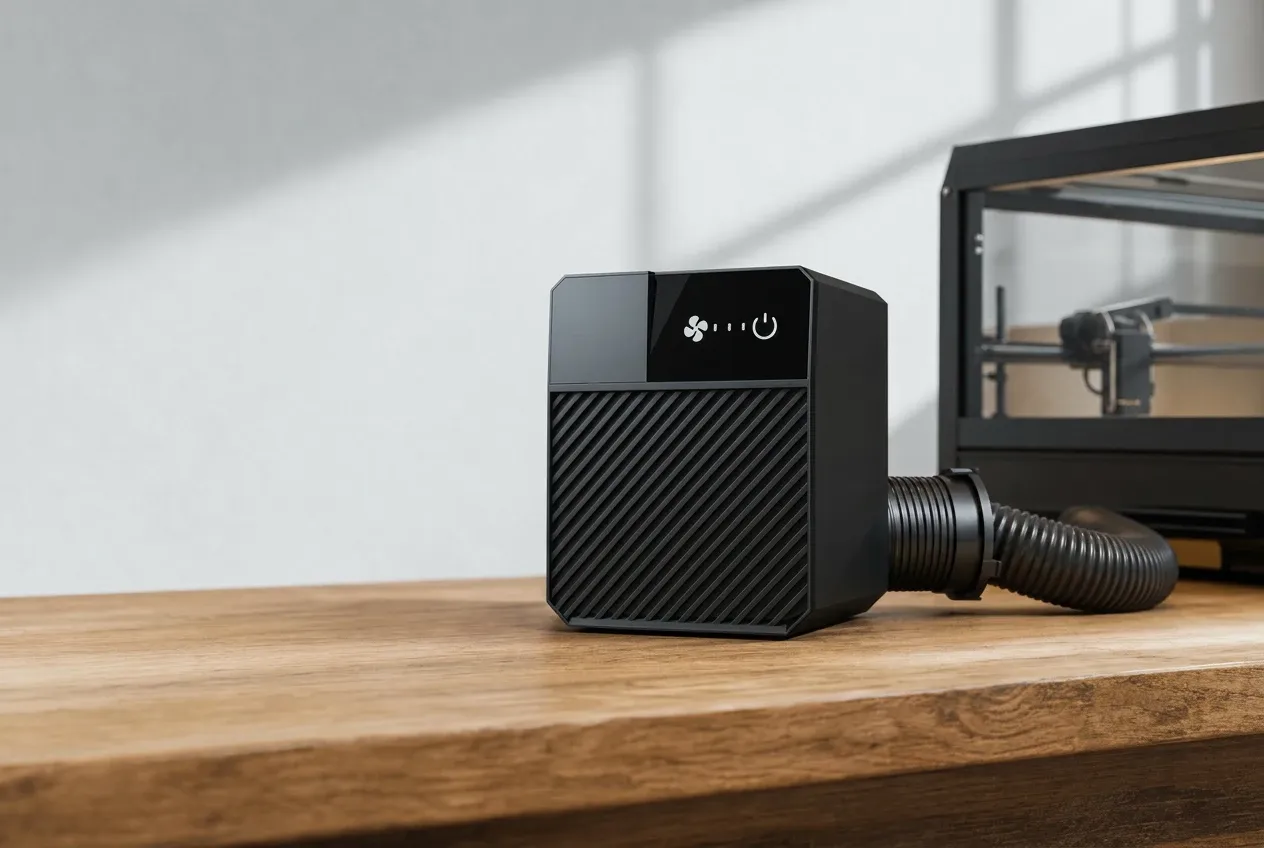
For users seeking a compact, workshop-friendly solution, Blazex AirP is designed around the needs of desktop laser environments. The focus is on practical indoor use: efficient filtration, space-conscious sizing and straightforward maintenance. As a result, it suits makers who need dependable extraction without giving up valuable bench space.
For UK buyers, that matters because many home and small-business workshops operate in converted rooms, garages or studios where footprint, noise and ease of servicing all play a part in day-to-day usability.
Frequently Asked Questions About HEPA Fume Extractors
What is a HEPA fume extractor?
A HEPA fume extractor is an LEV system that pulls polluted air away from the source and filters out fine airborne particles using high-efficiency media.
Do you need a HEPA fume extractor for laser cutting?
For most indoor laser cutting and engraving setups, yes. It helps control smoke and fine particulate matter more effectively than general room ventilation alone.
Is a HEPA filter enough for laser fumes?
No, not by itself in many cases. HEPA is ideal for particles, while activated carbon is typically needed for gases, fumes and odours.
What does COSHH say about fumes and dust?
COSHH requires hazardous substances to be assessed and controlled. According to UK guidance, controlling emissions at source is usually the preferred approach.
Ready to try Blazex AirP?
Shop Now — £119.20