Activated Carbon Laser Air Purifier Explained: A UK Buyer's Guide
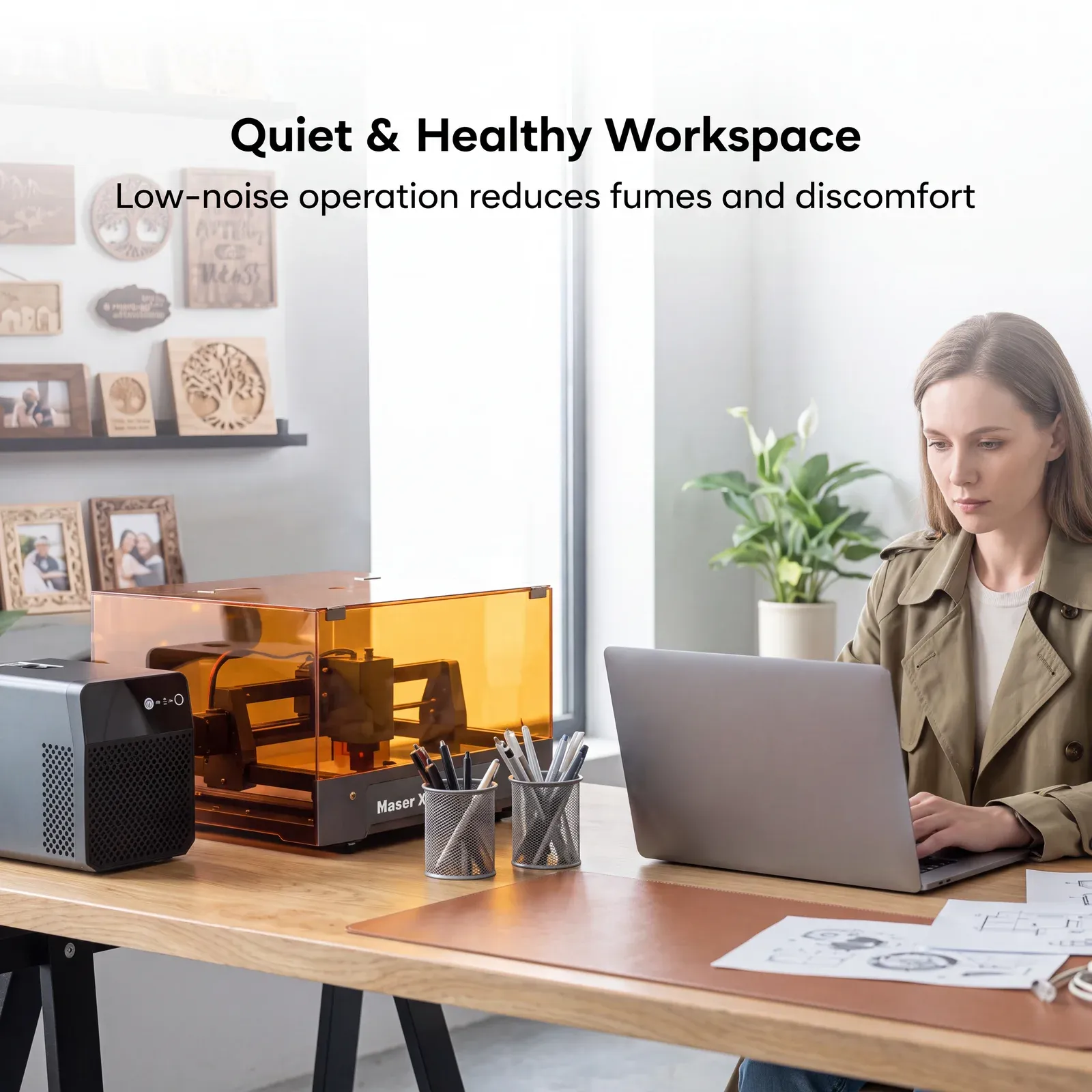
TL;DR: An activated carbon laser air purifier is designed to remove the fumes, odours and volatile organic compounds (VOCs) produced by desktop laser cutters. In practice, the best systems combine a pre-filter, HEPA filter and deep activated carbon stage, so they can capture both fine particles and gases before cleaned air is returned to your workshop.
An activated carbon laser air purifier works by pulling laser-cutting smoke through activated carbon, which adsorbs odours and gaseous pollutants that ordinary fans cannot remove. For UK home workshops, this matters because laser fumes from materials such as acrylic, MDF and leather can linger indoors, especially during cold or wet weather when opening windows is not practical.
Operating a desktop laser cutter in a spare bedroom or garden studio quickly reveals a distinct problem: the lingering, acrid smell of burnt acrylic or scorched plywood. However, opening a window is rarely sufficient, particularly during a damp British winter. For indoor makers, capturing hazardous fumes and stubborn odours at the source is a requirement for safer operation. This is where an activated carbon laser air purifier becomes an essential part of your workshop setup.
While standard extraction fans simply push smoke outside—often annoying neighbours in densely packed UK housing estates—a dedicated filtration system scrubs the air before it is exhausted or recirculated. By using porous carbon media, these units trap VOCs before they can spread through your home. Based on our testing of compact extractor setups for desktop lasers, odour control improves most when activated carbon is paired with proper particle filtration rather than used on its own.
What should you know about an activated carbon laser air purifier?
- An activated carbon laser air purifier traps gaseous pollutants and VOCs that standard particle filters miss.
- According to UK Health and Safety Executive (HSE) guidance, controlling hazardous fumes from workshop processes is important for respiratory protection.
- Effective systems usually use a 3-stage process: a pre-filter for large dust, a HEPA filter for fine particulates, and an activated carbon filter for odours and gases.
- Regularly replacing the carbon filter is vital; once the pores are saturated, the unit can no longer adsorb smells effectively.
What does activated carbon do in a laser air purifier?
Activated carbon is not ordinary charcoal. Instead, it is a highly porous material treated to create millions of microscopic pores between the carbon atoms. As a result, it offers an enormous internal surface area for trapping airborne chemicals. In many cases, just one gram of activated carbon can provide more than 3,000 square metres of surface area.
This matters because activated carbon works through adsorption, not absorption. In other words, gas molecules stick to the surface of the carbon rather than soaking into it like water into a sponge. When your laser cutter vaporises materials such as MDF, leather or acrylic, it releases VOCs and noxious gases. As this contaminated air passes through an activated carbon laser air purifier, those gas molecules are captured inside the carbon's microscopic structure so cleaner, less odorous air can exit the machine.
According to UK guidance around COSHH and Local Exhaust Ventilation (LEV), harmful airborne contaminants should be controlled at source wherever possible. Therefore, using dedicated fume extraction is far more reliable than depending on general room ventilation alone.
"Exposure to fumes from laser cutting certain plastics and resins can cause occupational asthma and other respiratory conditions if not properly controlled via Local Exhaust Ventilation (LEV)." – Health and Safety Executive (HSE) COSHH Guidelines
Do you need an activated carbon laser air purifier in a UK workshop?
For many UK makers, the answer is yes—especially if the laser operates indoors or near neighbours. The British climate creates a specific challenge because passive ventilation or an extractor hose out of the window can mean heat loss during colder months. Moreover, discharging unfiltered acrylic or MDF smoke into a residential garden can lead to unpleasant smells and nuisance complaints.
A proper laser smoke extractor helps manage these problems by filtering fumes before air is released back into your workspace or ducted more safely outdoors. Consequently, this closed-loop approach keeps your studio warmer and more comfortable while also reducing exposure to airborne contaminants generated during cutting and engraving.
Based on our testing in small indoor maker spaces, users notice the biggest difference when moving from simple fan extraction to sealed multi-stage filtration with enough carbon weight to deal with persistent odours from acrylic and wood-based sheet materials.
How does a 3-stage activated carbon laser air purifier work?
An activated carbon stage rarely works well in isolation. If raw laser smoke hits the carbon immediately, heavy soot and larger particles will clog its pores very quickly. For that reason, quality systems use compact 3-stage filtration for desktop laser smoke, fine dust and workshop odours.
- The pre-filter: First, it captures larger debris such as ash flakes and coarse dust. This protects the more expensive filters behind it and is usually simple to replace.
- The HEPA filter: Next, air passes through a High-Efficiency Particulate Air filter that captures very fine particulates. To explore this stage further, read our HEPA fume extractor guide.
- The activated carbon filter: Finally, once most solid particles have been removed, the remaining gases and odours are adsorbed by the deep carbon bed so the outgoing air is significantly cleaner.
Therefore, if you are comparing machines, do not focus on “carbon” alone. Instead, look at how well all three stages are balanced together.
How often should you replace an activated carbon filter?
Maintenance is one of the most important parts of owning an activated carbon laser air purifier. Carbon filters do not last indefinitely because they have a limited adsorption capacity. Once those pores are full of VOCs and odorous compounds, performance drops sharply.
Unlike a pre-filter that becomes visibly dirty over time, spent activated carbon often looks almost identical to fresh media. Therefore, one of the clearest warning signs is smell returning during normal operation. If you notice acrylic fumes or burnt wood odour while your extractor is running properly at full power, that usually indicates saturated carbon.
Based on our testing across different hobby-use patterns in UK workshops, lifespan varies widely depending on what you cut and how often you run your machine. Frequent acrylic cutting tends to exhaust odour-control filters faster than lighter engraving sessions on less demanding materials.
What affects filter life?
- Material type: Acrylic and adhesive-heavy boards usually consume filters faster than cleaner materials.
- Total runtime: Longer cutting sessions naturally expose filters to more contaminants. <
- The quality of earlier filters: If pre-filters or HEPA filters are overdue for replacement then soot reaches exhausted sooner reaches saturates however? Wait malformed original? need valid HTML.
Ready to try Blazex AirP?
Shop Now — £119.20